

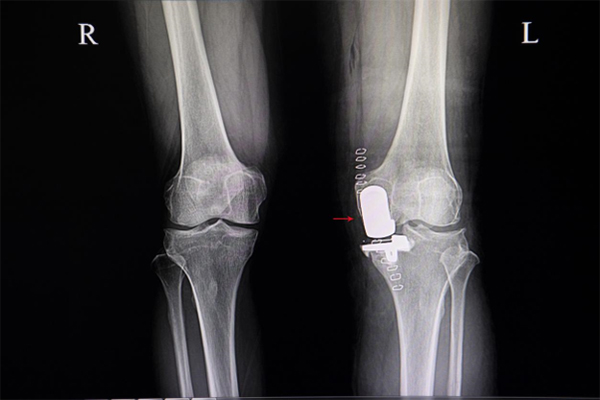
Not every arthritic knee needs to be fully replaced. For some patients, only one section of the joint has broken down while the rest remains reasonably healthy, and replacing the entire knee when only part of it is damaged is not always the better choice. The challenge has always been making that distinction accurately and executing the right procedure precisely. This is exactly where robotic technology has changed what is possible for both decisions.
The Knee Has Three Compartments, and That Detail Matters
The knee joint is divided into three distinct compartments: the medial side on the inside of the knee, the lateral side on the outside, and the patellofemoral compartment between the kneecap and the thigh bone. Osteoarthritis does not always affect all three equally. When damage is largely confined to one compartment, typically the medial side, a partial knee replacement, also called a unicondylar or unicompartmental replacement, replaces only that section while leaving the unaffected portions of the joint intact. A total knee replacement resurfaces all three compartments regardless of their individual condition.
Why Choosing Between Them Is Not Always Straightforward
The case for a partial replacement is compelling when the right patient is identified: smaller procedure, faster recovery, less bone removed, and a knee that often feels more natural because the undamaged tissue and ligaments are preserved. The catch is that partial replacement only works well when the damaged area is genuinely isolated, the remaining cartilage is in acceptable condition, and the knee's alignment and ligament integrity meet specific criteria. Missing those requirements and proceeding with a partial replacement when the damage is more widespread leads to predictably poor outcomes and a higher likelihood of eventually needing revision to a total replacement.
Where Robotic Guidance Changes the Equation
Two things have historically made partial knee replacement less reliable than it could be: selection errors and positioning errors. Robotic technology addresses both. Before surgery, a CT scan builds a detailed three-dimensional model of the patient's specific knee anatomy, allowing the surgical plan to be mapped against the actual distribution of cartilage damage and the mechanical axis of the leg. This preoperative picture adds an objective layer to what was previously a judgment call made largely from two-dimensional X-rays and a physical exam.
During the procedure itself, the robotic arm provides real-time boundaries that keep bone preparation and implant positioning within the planned parameters, reducing the variability that comes with manual instrumentation. For a unicondylar replacement in particular, where the margin for positioning error is smaller than in total replacement due to the tighter fit required against preserved native cartilage, that precision is not a secondary benefit. It is what makes the procedure consistently reliable rather than technique-dependent.
Total Replacement Benefits From the Same Precision
Patients who do need a full knee replacement benefit from the same preoperative planning and intraoperative guidance, with robotic assistance supporting accurate implant alignment, consistent gap balancing between flexion and extension, and reproducible soft tissue tension throughout the range of motion. The same technology that helps identify the right procedure also helps execute it more accurately, which is why robotic-assisted total knee replacement has shown consistent improvements in implant alignment and early functional recovery compared to conventional manual technique across multiple comparative studies.
Same-Day Surgery Is Now a Realistic Option for Both
When the right patient is matched to the right procedure and that procedure is executed with precision, recovery tends to be more predictable and more comfortable than patients typically expect. Both total and partial knee replacement can now be performed as outpatient procedures for appropriately selected patients, with same-day discharge replacing the multi-day hospital stay that once defined joint replacement recovery.
If knee pain has been limiting your daily activity and you want to understand whether a partial or total replacement fits your specific situation, a thorough evaluation with imaging is the most direct way to find out which option is actually on the table.
Frequently Asked Questions
1. What is the difference between partial and total knee replacement?
Partial knee replacement resurfaces only the damaged compartment of the knee while preserving healthy tissue, while total knee replacement resurfaces all three compartments of the joint regardless of individual condition.
2. How do doctors decide between partial and total knee replacement?
The decision depends on how many compartments are damaged, the condition of remaining cartilage, knee alignment, and ligament integrity, with robotic preoperative planning now adding an objective, anatomy-specific layer to that evaluation.
3. Is partial knee replacement better than total knee replacement?
For the right candidate, partial replacement offers faster recovery and a more natural feeling knee, but it only works well when damage is genuinely confined to one compartment and specific anatomical criteria are met.
4. Does robotic surgery improve outcomes for knee replacement?
Robotic-assisted knee replacement has been shown to improve implant alignment accuracy and early functional recovery compared to manual technique, for both partial and total knee replacement procedures.
5. Can knee replacement be done as outpatient surgery?
Yes. Both partial and total knee replacement can now be performed on an outpatient basis for appropriately selected patients, allowing same-day discharge and recovery at home rather than an extended hospital stay.
Reference Links:
- Robot-assisted partial knee replacement versus standard total knee replacement (RoboKnees): a protocol for a pilot randomized controlled trial - PubMed Central
- Comparing robot-assisted and conventional surgery in knee replacement: A meta-analysis of surgical-site wound complications and recovery outcomes - ScienceDirect
AUTHOR: Dr. Christopher W. Palmer, DO – Orthopedic Surgeon & Robotic Total Joint Replacement Specialist
Dr. Christopher W. Palmer, DO is an orthopedic surgeon specializing in Mako robotic-assisted total joint replacement, minimally invasive joint procedures at Signature Medical Group. Recognized as a leading robotic total joint surgeon in Missouri, Dr. Palmer has performed more than 2,000 robotic joint replacement procedures and brings advanced, technology-driven orthopedic care to the St. Louis area through Signature Orthopedics.
Credentials & Education
Dr. Palmer earned his Doctor of Osteopathic Medicine degree from A.T. Still University/Kirksville College of Osteopathic Medicine. He completed his internship at Des Peres Hospital and his orthopedic surgery residency at Des Peres Hospital in affiliation with Saint Louis University and Cardinal Glennon Children’s Hospital. He also holds a bachelor’s degree in microbiology from Weber State University, providing a strong academic foundation in infectious disease research and surgical safety. He maintains multiple advanced certifications, including Advanced Trauma Life Support (ATLS), Advanced Cardiovascular Life Support (ACLS), Pediatric Advanced Cardiovascular Life Support (PALS), Basic Life Support (BLS), and National Institutes of Health Stroke Scale (NIHSS) certification. Dr. Palmer is an active member of the American Academy of Orthopaedic Surgeons (AAOS) and the American Association of Hip and Knee Surgeons (AAHKS), reflecting his commitment to advancing orthopedic care and staying current with the latest developments in hip and knee surgery.
Clinical Expertise
Dr. Palmer focuses on robotic-assisted total and partial joint replacement of the hip and knee, minimally invasive joint procedures, joint arthroscopy, and orthopedic trauma. His expertise in robotic technology allows for enhanced surgical precision, personalized implant positioning, and optimized recovery pathways.
In addition to his clinical practice, Dr. Palmer serves as a board member at Steri 3X and as a medical consultant for Convatec and Ethicon, contributing to advancements in infection prevention, wound care, and surgical innovation.
Medical Disclaimer: This information is for educational purposes only and does not constitute medical advice. For diagnosis and treatment recommendations, please consult with Dr. Palmer or another qualified orthopedic specialist.


