

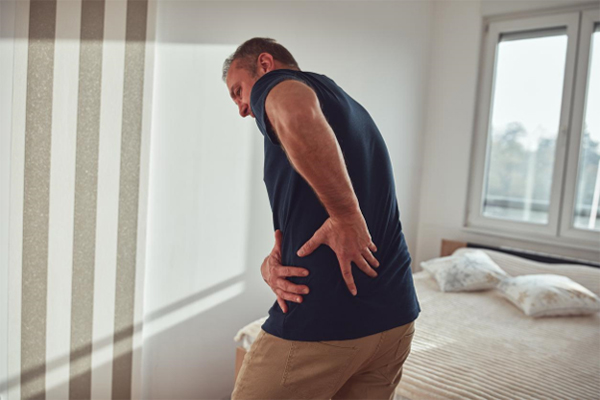
Hip pain can be surprisingly difficult to pinpoint. A deep ache in the groin often points to the hip joint itself, while discomfort along the outer hip may involve the tendons or other soft tissues nearby. In some cases, what feels like hip pain is actually referred pain originating in the lower back. Because the true source isn't always obvious, recognizing the warning signs and knowing when to seek a specialist's evaluation can make all the difference in getting the right diagnosis and treatment.
Where You Feel Hip Pain Can Offer Important Clues
The location of your pain can provide useful information about what may be causing it.
Pain felt deep within the hip or groin is more likely to originate from the hip joint itself. Arthritis, cartilage damage, and other joint conditions can cause this type of discomfort.
Pain on the outside of the hip, upper thigh, or buttocks may instead involve muscles, tendons, ligaments, or other soft tissues surrounding the joint. Problems in the lower back can also produce symptoms that patients interpret as hip pain.
What Does Hip Arthritis Usually Feel Like?
Hip arthritis occurs when the cartilage that normally allows the joint surfaces to move smoothly becomes damaged or worn.
Common symptoms include deep hip or groin pain, stiffness, reduced range of motion, and discomfort that may increase with activity. As arthritis progresses, everyday movements such as walking, bending, climbing stairs, or getting in and out of a car can become increasingly difficult.
Some people also experience pain after sitting or resting for an extended period. In more advanced cases, discomfort can interfere with sleep or occur even when the hip is not being used.
Arthritis is the primary indication for total hip replacement and describes pain, stiffness, limited motion, and difficulty with activity as common symptoms.
Hip Bursitis Can Cause Pain Outside the Joint
Not all hip pain comes from arthritis.
Bursitis involves irritation of a bursa, a small fluid-filled structure that helps reduce friction between tissues. Hip bursitis commonly produces tenderness and discomfort around the outside of the hip. Lying on the affected side or putting pressure on the area may make symptoms more noticeable.
Bursitis is a possible cause for hip pain and distinguishes pain around the outside of the hip from symptoms more likely to originate inside the joint.
If your pain is primarily located over the outer hip rather than deep in the groin, a specialist can help determine whether the joint itself is actually responsible.
Could Tendonitis Be Causing Your Hip Pain?
Tendons connect muscles to bones and help control movement around the hip. Repetitive activity, overuse, or strain can irritate these structures and cause pain.
Tendon-related hip pain may become more noticeable during specific movements or after increased physical activity. Unlike arthritis, which involves degeneration within the joint, tendon problems involve the soft tissues surrounding it.
This distinction matters because treatment depends on the underlying cause. A person with tendon irritation may benefit from activity modification, physical therapy, or other nonsurgical care rather than joint replacement.
Sometimes "Hip Pain" Comes From Your Lower Back
One of the more confusing aspects of hip pain is that the hip may not actually be the source.
Conditions affecting the lower back can cause pain that radiates into the buttocks, hip region, or leg. This can make it difficult to determine whether the problem involves the hip joint, spine, nerves, or surrounding soft tissues.
A specialist evaluation can help separate these possibilities. Low-back problems are among the potential causes for symptoms perceived as hip pain.
That is one reason a comprehensive examination is more useful than assuming that every ache near the hip represents arthritis.
Other Conditions Can Mimic Hip Arthritis
Arthritis, bursitis, tendonitis, and back problems are not the only potential causes of hip pain.
Injuries, sprains and strains, infection, and osteonecrosis are also possible causes. Osteonecrosis occurs when reduced blood supply damages bone tissue, potentially affecting the hip joint.
Sudden, severe hip pain after an injury deserves particular attention. Hip fractures can cause significant pain and require prompt medical evaluation, especially in older adults or people with weakened bone.
Because several different conditions can produce overlapping symptoms, persistent or worsening pain should not automatically be attributed to aging or arthritis.
When Should You See a Hip Specialist?
Occasional soreness after an unusually demanding activity does not necessarily mean you need to see an orthopedic specialist immediately.
However, an evaluation becomes more important when hip pain:
- Persists despite rest or activity modification
- Continues to worsen over time
- Interferes with sleep
- Limits walking or exercise
- Makes stairs or bending difficult
- Causes stiffness or reduced range of motion
- Produces a limp
- Interferes with work or everyday activities
- Returns repeatedly despite conservative treatment
Evaluation is recommended when hip symptoms are affecting function and conservative treatment is no longer providing adequate relief.
How Is the Cause of Hip Pain Diagnosed?
Diagnosing hip pain starts with understanding your symptoms.
A physician may ask when the pain began, where you feel it, what activities make it worse, whether it occurs at rest, and whether you have experienced an injury. A physical examination can then assess movement, strength, tenderness, gait, and other factors.
Imaging may also be necessary. X-rays and other scans are tools that can help evaluate the underlying condition.
The goal is to identify the actual source of your symptoms rather than simply treating the location where you feel pain.
Does Hip Pain Always Mean You Need Surgery?
No.
Many hip conditions can initially be managed with nonsurgical approaches. Depending on the diagnosis, treatment may include activity modification, anti-inflammatory medications, physical therapy, exercises, or injections.
Conservative treatments are generally considered before hip replacement. Surgery may become an option when symptoms remain significant despite appropriate nonsurgical care and the underlying joint damage is advanced.
The decision should be based on both the condition of the joint and the degree to which symptoms affect your quality of life.
When Is Hip Replacement Worth Discussing?
Hip replacement may become appropriate when arthritis or another degenerative condition has significantly damaged the joint and continues to interfere with everyday life despite conservative treatment.
Signs that it may be time to discuss surgical options include persistent pain, difficulty walking, limited hip movement, sleep disruption, and an inability to participate in activities that are important to you.
Several approaches for appropriately selected patients include direct anterior hip replacement, minimally invasive hip replacement, outpatient anterior hip replacement, and Mako SmartRobotics-assisted total hip replacement.
What Role Does Mako Robotic Technology Play?
For patients who are candidates for robotic-assisted hip replacement, Mako SmartRobotics can provide additional planning and intraoperative guidance.
CT-based three-dimensional planning is used to create a personalized surgical plan based on the patient's anatomy. During surgery, the surgeon guides the robotic arm within the planned boundaries, while Mako's AccuStop technology helps maintain those boundaries. The surgeon remains in control and can make adjustments when necessary.
Robotic technology does not mean that a robot performs the operation independently. Rather, it provides another tool to support the surgeon's planning and execution of the procedure.
Frequently Asked Questions About Hip Pain and Arthritis
How can I tell if my hip pain is arthritis?
Hip arthritis commonly causes deep hip or groin pain, stiffness, reduced range of motion, and difficulty with activities such as walking or climbing stairs. However, these symptoms can overlap with other conditions, so an examination and appropriate imaging may be needed to confirm the cause.
What does hip bursitis feel like compared with arthritis?
Bursitis commonly causes pain and tenderness around the outside of the hip, while arthritis more often produces deeper pain in the hip or groin along with stiffness and restricted movement. A specialist can determine which structure is producing your symptoms.
Can back problems cause hip pain?
Yes. Conditions affecting the lower back can cause pain in the buttocks, hip region, or leg. Because hip and lower-back symptoms can overlap, a physical examination can help determine whether the hip joint or another structure is responsible.
When should I see an orthopedic specialist for hip pain?
Consider seeing a specialist when pain persists, worsens, interferes with sleep or daily activities, limits your mobility, or does not improve with appropriate conservative treatment. Severe pain following an injury warrants prompt medical evaluation.
Does hip arthritis always require hip replacement?
No. Early or less advanced arthritis may be managed with nonsurgical treatments such as physical therapy, medication, activity modification, or injections. Hip replacement may be considered when arthritis becomes advanced and symptoms continue to significantly affect daily life despite conservative treatment.
Know the Source Before Choosing the Treatment
Hip pain is a symptom, not a diagnosis. Arthritis may be responsible, but bursitis, tendon problems, injuries, osteonecrosis, and even conditions affecting the lower back can produce similar complaints. If persistent hip pain is changing how you walk, sleep, exercise, or manage everyday activities, an evaluation with a specialist can help identify the source and clarify whether nonsurgical care, hip preservation, or joint replacement is the appropriate next step.
Reference Links:
AUTHOR: Dr. Christopher W. Palmer, DO – Orthopedic Surgeon & Robotic Total Joint Replacement Specialist
Dr. Christopher W. Palmer, DO is an orthopedic surgeon specializing in Mako robotic-assisted total joint replacement, minimally invasive joint procedures at Signature Medical Group. Recognized as a leading robotic total joint surgeon in Missouri, Dr. Palmer has performed more than 2,000 robotic joint replacement procedures and brings advanced, technology-driven orthopedic care to the St. Louis area through Signature Orthopedics.
Credentials & Education
Dr. Palmer earned his Doctor of Osteopathic Medicine degree from A.T. Still University/Kirksville College of Osteopathic Medicine. He completed his internship at Des Peres Hospital and his orthopedic surgery residency at Des Peres Hospital in affiliation with Saint Louis University and Cardinal Glennon Children’s Hospital. He also holds a bachelor’s degree in microbiology from Weber State University, providing a strong academic foundation in infectious disease research and surgical safety. He maintains multiple advanced certifications, including Advanced Trauma Life Support (ATLS), Advanced Cardiovascular Life Support (ACLS), Pediatric Advanced Cardiovascular Life Support (PALS), Basic Life Support (BLS), and National Institutes of Health Stroke Scale (NIHSS) certification. Dr. Palmer is an active member of the American Academy of Orthopaedic Surgeons (AAOS) and the American Association of Hip and Knee Surgeons (AAHKS), reflecting his commitment to advancing orthopedic care and staying current with the latest developments in hip and knee surgery.
Clinical Expertise
Dr. Palmer focuses on robotic-assisted total and partial joint replacement of the hip and knee, minimally invasive joint procedures, joint arthroscopy, and orthopedic trauma. His expertise in robotic technology allows for enhanced surgical precision, personalized implant positioning, and optimized recovery pathways.
In addition to his clinical practice, Dr. Palmer serves as a board member at Steri 3X and as a medical consultant for Convatec and Ethicon, contributing to advancements in infection prevention, wound care, and surgical innovation.
Medical Disclaimer: This information is for educational purposes only and does not constitute medical advice. For diagnosis and treatment recommendations, please consult with Dr. Palmer or another qualified orthopedic specialist.


